Private AI Services: Will We Create Utopia or Dystopia?
Updated on: October 15, 2025
Artificial Intelligence has become one of the most transformative forces of our time. It promises to increase efficiency, enhance decision-making,…

Many businesses that believe they have internet redundancy do not. They have two connections from the same carrier, two circuits running through the same physical conduit, or a primary line paired with a 4G LTE backup that cannot sustain real business load. When an outage occurs, they discover that having two connections and having two independent paths are not the same thing.
Understanding the distinction between redundancy and path diversity changes how a business should evaluate its network setup.
Redundancy simply means having more than one of something. A second internet connection is redundant in the sense that it functions as a spare. The more important question is whether that second connection shares any infrastructure with the first.
If a primary connection fails because a fiber conduit beneath the street was cut during construction, and the backup connection runs through that same conduit, the business loses both connections at once. They failed simultaneously because they shared a single point of failure. In that scenario, the redundancy was illusory.
This situation is more common than most businesses assume. Carriers frequently sell “redundant” connections that route through the same local loop, the same building entrance point, or the same regional node. From the customer’s perspective, it looks like two separate services. From an infrastructure standpoint, a single construction crew with a backhoe can take out both at once.
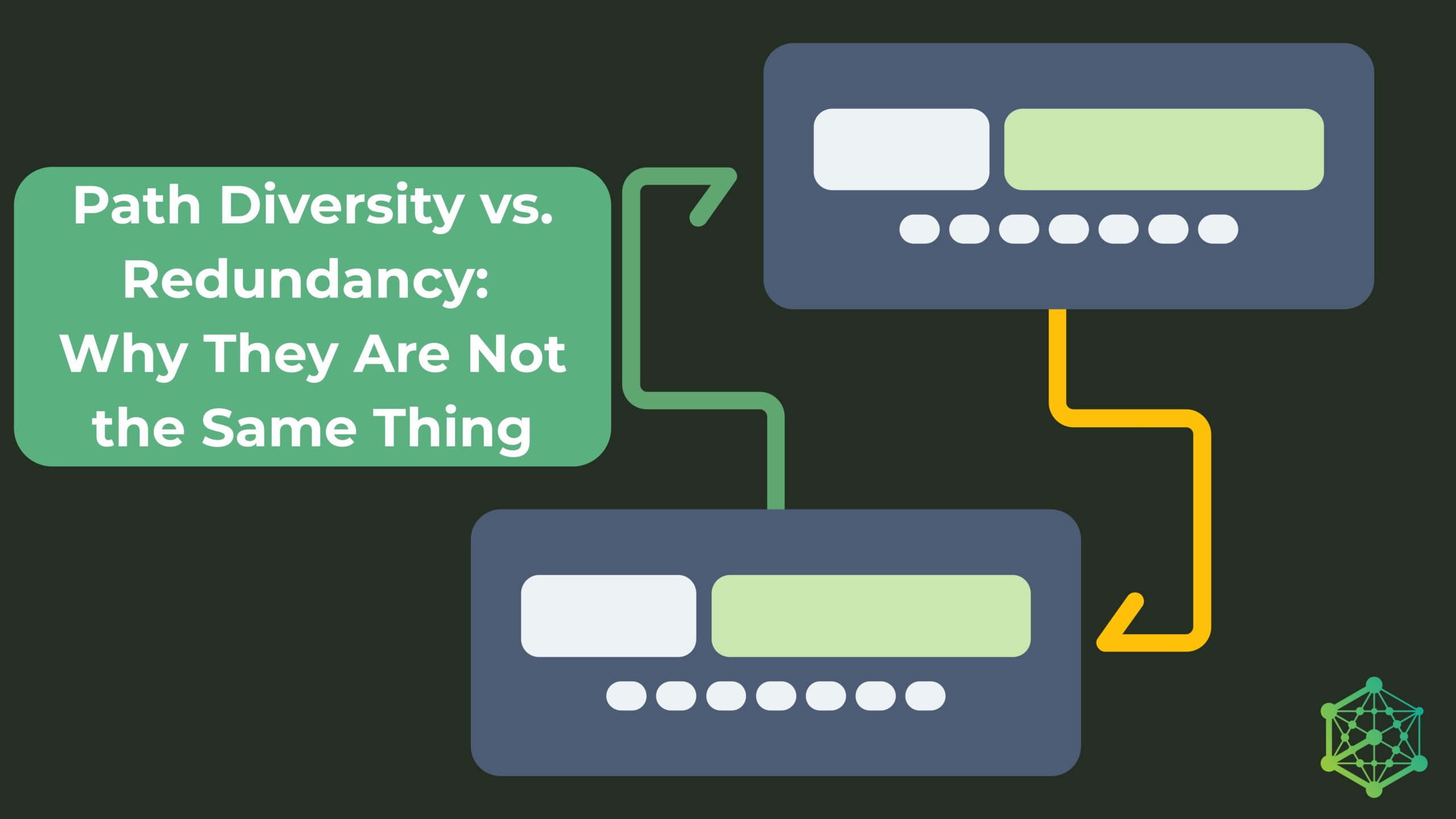
Path diversity means two connections take genuinely different physical routes from a location to the internet: different physical infrastructure, different building entry points, different upstream carriers, and different geographic routing. If one path fails, for any reason, the second is unaffected because it does not share the same failure modes.
This is what real business continuity looks like in practice. Not two connections from the same provider that happen to be billed separately, but two connections built on different technologies running over physically separate infrastructure.
For most Bay Area businesses, the strongest combination pairs fiber or fixed wireless from a local independent provider with a different technology from a different network operator, such that the two paths share nothing below the customer premises equipment.
For Etheric customers, this typically takes one of two forms:
In either configuration, the Etheric connection runs on infrastructure the company owns and operates, which means it has different failure modes, different physical routes, and different upstream paths than a typical carrier circuit. If a carrier’s regional node fails, Etheric’s network is unaffected by that event, and the reverse holds true as well.
Fixed wireless carries one significant advantage as a secondary path: its last-mile delivery mechanism is fundamentally different from fiber’s. Fiber depends on physical cable in the ground. Fixed wireless depends on line-of-sight radio transmission between a location and a tower. The failure scenarios that affect one rarely affect the other.
A fiber cut that disables cables throughout an area has no bearing on a fixed wireless signal. A power failure at a carrier facility does not affect a separately powered tower on a different electrical grid. This physical independence is what makes a combination genuinely diverse rather than redundant in name only.
Etheric’s fixed wireless terminates into its private dark fiber ring, which connects eight Bay Area data centers with direct peering to major content networks. The last mile is wireless; the backbone is fiber the company owns.[1]
The following questions, posed directly to a current provider, can reveal whether an existing “redundant” setup is genuinely diverse:
If the honest answer to any of these is yes, the business has redundancy on paper but not path diversity in practice.
Etheric Networks provides fixed wireless internet as either a primary or secondary path for Bay Area businesses. Its network is physically independent from every major carrier’s infrastructure, which makes it a genuine second path rather than a second connection on shared infrastructure. Etheric reports deployment in three to five business days.
What is the difference between a backup internet connection and a diverse path? A backup connection is simply any second connection. A diverse path is a second connection that shares no physical infrastructure with the first. The distinction matters at the moment physical infrastructure fails: a diverse path survives that event, while a backup riding the same infrastructure fails alongside the primary.
How does automatic failover work? With a properly configured router, failover between a primary and secondary connection can occur automatically, often in under thirty seconds. When the primary connection drops, the router detects the failure and shifts traffic to the secondary path without manual intervention. Most business-grade routers support this capability natively.
Does having two connections double the cost? A second connection is an additional line item, but the relevant comparison is the cost of a complete outage — lost revenue, lost productivity, contractual penalties, and reputational damage — against the monthly cost of a second path. For most Bay Area businesses with any meaningful exposure to downtime, that comparison favors the second connection.
Is 4G LTE a real backup path? From a purely physical standpoint, yes: cellular infrastructure is genuinely independent of fixed wireline and fixed wireless networks. The limitation is performance under sustained load, since LTE connections can slow considerably when carrying business traffic. It functions reasonably well as an emergency path for light use but is not a substitute for a business-grade secondary connection over any extended period.
[1] Network architecture and backbone connectivity figures are drawn from Etheric Networks’ internal infrastructure documentation, June 2026.